10/31/25

Location and Exterior Approach
SAKEBARO Kyoto is located in a residential neighborhood along the Shirakawa in Higashiyama, Kyoto. It sits slightly away from the heart of the tourist area, in a quiet setting. The site itself is set a little back from the street, surrounded by calm residential streets. While the exterior follows a machiya (traditional townhouse) look, it is not a typical “renovated old house” type of shop. Rather than the common Kyoto approach of “preserving and refurbishing a row house as-is while retaining the good old elements,” we intentionally chose the opposite direction. The exterior may appear machiya-like, but the moment you step inside, we want you to feel, “This is not an old house.”
立地と外観のアプローチ
SAKEBARO 京都店について SAKEBARO京都店は、京都・東山、白川沿いの住宅街の中にあります。観光エリアの中心からは少し外れた、静かな場所です。立地としても、通りから少し奥に入ったところで、周囲は落ち着いた住宅地です。 外観は町家風のつくりですが、いわゆる古民家再生型の店舗とは異なります。京都ではよく見られる「長屋をそのまま活かして、古き良きものを残しつつ改装しました」というアプローチではなく、私たちは“あえて”それとは逆の方向を選んでいます。外観こそ町家風に見えますが、中に入った瞬間、「これは古民家じゃない」と思わせるような空間にしています。


Layout: 1F Counter & 2F Tatami Room
The building has two levels: a counter bar on the first floor and a tatami-style space on the second. At the first-floor entrance, shoji lighting is installed, and the plants and flowers are changed seasonally. The lighting is set so that from the outside the interior appears quite bright. However, once you actually enter, the space is very dark, illuminated only by light akin to faint moonlight. Many people are surprised by this contrast between the brightness seen from outside and the darkness within. 構成:1階カウンターと2階お座敷
建物は二層構造で、1階がカウンターバー、2階が座敷スペースになっています。 1階の入り口には、障子の照明が配置されており、季節ごとに植物や花を変えて設えています。照明の明るさによって、外から見ると中がかなり明るく見えるように設計しています。しかし、実際に入店してみると、空間は非常に暗く、ほのかな月明かりのような照明しか灯っていません。この外からの明るさと中に入ったときの暗さのギャップに、多くの人が驚きます。


Gold-Leaf Counter and Rain Installation
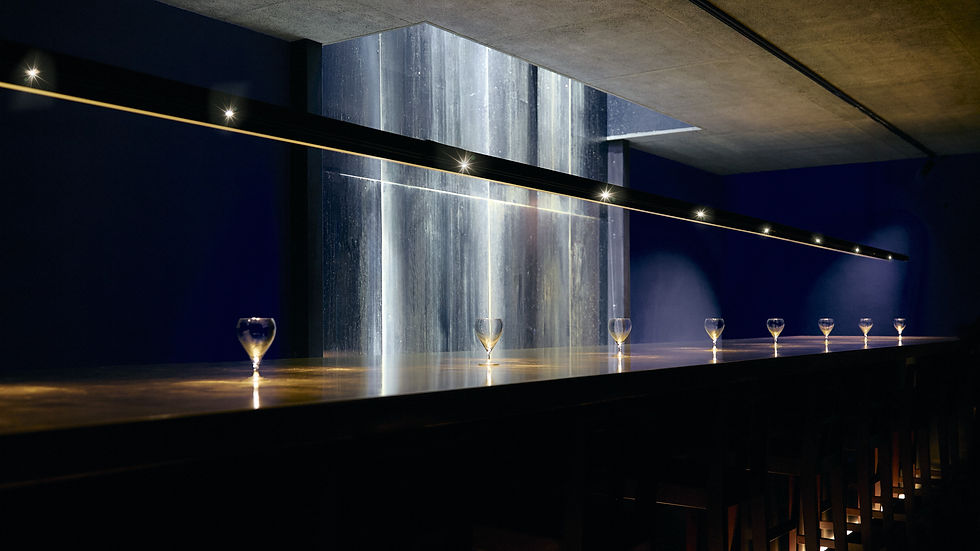
The first-floor counter measures about 1.2 meters wide and roughly 7 meters long, and its entire surface is covered in gold leaf. Artisans applied each sheet by hand, a painstaking process. As in the Nakameguro location, the lighting scheme uses spotlights to pick out glasses and vessels in an otherwise dark room, so the gold leaf does not glare; instead, it shows a well-balanced, shadowed beauty. This property used to be a fishmonger decades ago. There was a grill station for takeout and a chimney rising from it. We utilized the remnant of that chimney as a device to make rain fall. Water drips slowly from the ceiling, tapping onto the stone paving beside the counter with a soft “sara” sound. It is designed to recreate that quiet sound of rain in a temple or garden. Furthermore, the ceiling includes a mechanism to install cherry blossoms. In spring, petals fall slowly from there, allowing you to sip sake at the first-floor counter while watching the blossoms “scatter.” This is an effect not found in our other locations. In addition, there is also a mechanism to let snow fall, allowing guests to enjoy “yukimi-zake” (snow-viewing sake) in accordance with the season or event. 金箔のカウンターと雨の演出
金箔のカウンターと雨の演出 1階のカウンターは、幅1.2m、長さ7m程度の大きさで、全面に金箔が貼られています。職人が一枚ずつ手作業で貼ったもので、非常に手間がかかっています。照明は中目黒店と同様に、暗い中でグラスや酒器をスポットで照らすような構成になっており、その光の中で金箔が光りすぎず、ちょうどよい陰影のある美しさになります。 この物件はもともと、何十年も前に営業していた魚屋でした。魚を焼いて持ち帰るための焼き場があり、そこから煙突が伸びていました。私たちはその煙突跡を活かし、今ではそのスペースから雨を降らせる装置として使っています。天井から水が少しずつ落ちてきて、カウンター横の石畳に当たり、「サラッ」と音が鳴ります。これは寺や庭で雨が降ったときの、あの静かな音を再現する意図で設計しました。 さらに、天井には桜の花を設置できる装置があります。春にはそこから花びらが少しずつ落ちる仕組みで、1階カウンターで日本酒を飲みながら“花が散る”様子を見るという体験ができます。これも他の店舗にはない演出です。加えて、雪を降らせる装置も備えており、季節やイベントに応じて“雪見酒”を楽しんでもらうような設計にもしています。


Lighting Modes and Event Support
The lighting can switch between two modes: a Nakameguro style and an Aoyama style. Normally we use the Nakameguro method, where spotlights gently illuminate vessels and dishes; but it can also switch to the Aoyama store’s straight, single-rail lighting. Using this rail lighting makes the gold-leaf counter stand out with a crisper outline, ideal for events and parties. The counter is a rounded form, and during events guests can also enter the inside of the counter area. Spaces that are usually staff-only can be opened for standing guests, enabling a “round-format tavern” use similar to the Aoyama location. It can accommodate standing events for about 20–30 people. 照明の切り替えとパーティー対応
照明は、中目黒型と青山型の2種類を切り替えて使えるようになっています。通常はスポットライトで器や料理を柔らかく照らす中目黒の方式ですが、青山店で使用している一直線のレール照明にも切り替え可能です。このレール照明を使えば、金箔のカウンターがよりくっきりと輪郭を持ち、イベントやパーティーなどでも映える仕様になります。 カウンターはラウンド型になっており、イベント時にはお客様がカウンター内側にも入れる構成です。通常はスタッフ側となる場所にも、お客様がスタンディングで入り、青山店のような“ラウンド形式の酒場”としての使い方ができます。20〜30人規模の立食イベントにも対応可能です。


2F Tatami and a Recomposition of Samurai Culture
Guests ascend a dark staircase to the second floor. A faint light glows at the top, and the approach is composed so you move toward it. By transitioning from brightness into darkness, your vision is deliberately reset. The upstairs is conceived less as a typical tatami room and more as the chamber of a samurai residence. Rather than “decorating” in a Japanese motif, we use contemporary techniques and materials to bring samurai culture into the space as an attitude—an atmosphere of poise. Sake is poured not into glasses but boldly into tea bowls and similar vessels, encouraging a rough-hewn way of drinking. It evokes the mood of warriors sharing cups of sake, and we adopt that ruggedness by design. 2階のお座敷と武家文化の再構成
2階のお座敷と武家文化の再構成 2階へは、暗い階段を登ってもらいます。階段の先にほのかな光があり、それを目指して進む構成です。明るい場所から暗い場所へと移動し、視覚を一度リセットする設計になっています。 2階の空間は、一般的な座敷というよりも、武家屋敷の間を意識して設計しました。装飾を和風にするのではなく、現代の技術や素材を活かして、空間の“佇まい”として武家文化を取り入れた形です。 日本酒は、グラスではなく茶碗などの器にどんと注ぎ、無骨に飲むようなスタイルを採用しています。これは昔の武士が盃で酒を酌み交わしていたような雰囲気を想定したもので、武骨さをあえて取り入れています。


Stage Equipment: Projectors and Lighting
There is a stage on the second floor. It is built to accommodate performances by geiko and maiko, and we have installed two 4K projectors. One can project onto the shoji surfaces, and the other onto a screen revealed by opening the rear fusuma (sliding doors). The stage lighting is designed to avoid excessive brightness, reproducing the nuance of candlelight. All of the lighting is handcrafted and repeatedly tuned to achieve the optimal intensity and texture. As a result, the space can host a wide range of uses—performances, screenings, cultural events, banquets, meetings, and memorial services. It is prepared for practical use in geiko/maiko events, film viewings, lectures, and exhibitions.
舞台設備・プロジェクターと照明
2階には舞台があります。芸妓や舞妓の演舞に対応した作りで、プロジェクターは4K対応のものを2台設置。1台は障子面に、もう1台は奥の襖を開けてスクリーン面に映すことができます。 舞台照明も、明るすぎず、ろうそくのような光の加減を再現できるように設計しています。すべての照明はハンドメイドで制作され、何度も調整して最適な光量と質感に仕上げました。 これにより、演舞、上映、文化イベント、宴会、会合、追悼会など、多目的に対応可能です。実際に芸妓・舞妓イベント、映画鑑賞会、講演、作品展示などにも使用できるよう整えています。

Kitchen and Garden
Kitchen and Garden On the first floor, there is a small kitchen that can support simple dishes, dinners, and pop-up events. The garden employs one-way (magic) mirror surfaces to introduce visual depth, becoming particularly atmospheric at night. By day, it functions as a real garden; at night, it produces the illusion that the depth continues indefinitely. Going forward, we plan to install a cherry tree and artworks in this garden to broaden the range of spatial expression across the entire venue. キッチンと庭
1階には小型のキッチン設備もあり、簡易な料理やディナー提供、ポップアップイベントにも対応できます。 庭については、マジックミラーを使って視覚的な奥行きを持たせており、夜間は特に幻想的な空間になります。昼間はリアルな庭として機能しますが、夜になると、まるで奥行きがどこまでも続くような錯覚に陥ります。今後はこの庭に桜の木やアート作品を設置し、空間全体としても演出の幅を広げていく予定です。

Summary
Summary The Kyoto location is a flagship built upon elements accumulated in Nakameguro, Aoyama, and Fukuoka. Darkness, lighting, sound, materials, spatial structure, and performance devices—all of our learnings are integrated here. Through the experience of this store, guests can most readily understand what SAKEBARO aims for and what a sake-centric spatial experience can be. It is positioned as a hub that can be used both for outward explanations and for internal training.
総括
京都は、中目黒・青山・福岡の店舗で蓄積してきた要素をもとに構成された、フラッグシップ店舗です。 暗さ、照明、音、素材、空間の構造、演出装置、全てにおいてこれまでの経験を融合させています。 店舗の体験を通して、SAKEBAROが何を目指しているのか、日本酒の空間体験とはどういうものかを最も理解してもらいやすい設計になっており、外部向けの説明にも内部研修にも活用できる拠点として位置づけています。